The first AI that uses both what it sees and hears to hold a real conversation in a noisy room.
AV-Dialog: Spoken Dialogue Models with
Audio-Visual Input
(ACL 2026 Main conference) The 64th Annual Meeting of the Association for Computational Linguistics
Demo Videos
| Interference Speech1 | Interference Speech2 | Background Noise | Interference Speech3 | |
|---|---|---|---|---|
| Prior (SE+Moshi) |
Demo1: Audio-only baseline with interfering speakers
|
Demo2: Audio-only baseline with interfering speakers
|
Demo3: Audio-only baseline with background noise
|
Demo4: Audio-only baseline with interfering speakers
|
| Ours (AV-Dialog) |
Demo1: AV-Dialog with interfering speakers
|
Demo2: AV-Dialog with interfering speakers
|
Demo3: AV-Dialog with background noise
|
Demo4: AV-Dialog with interfering speakers
|
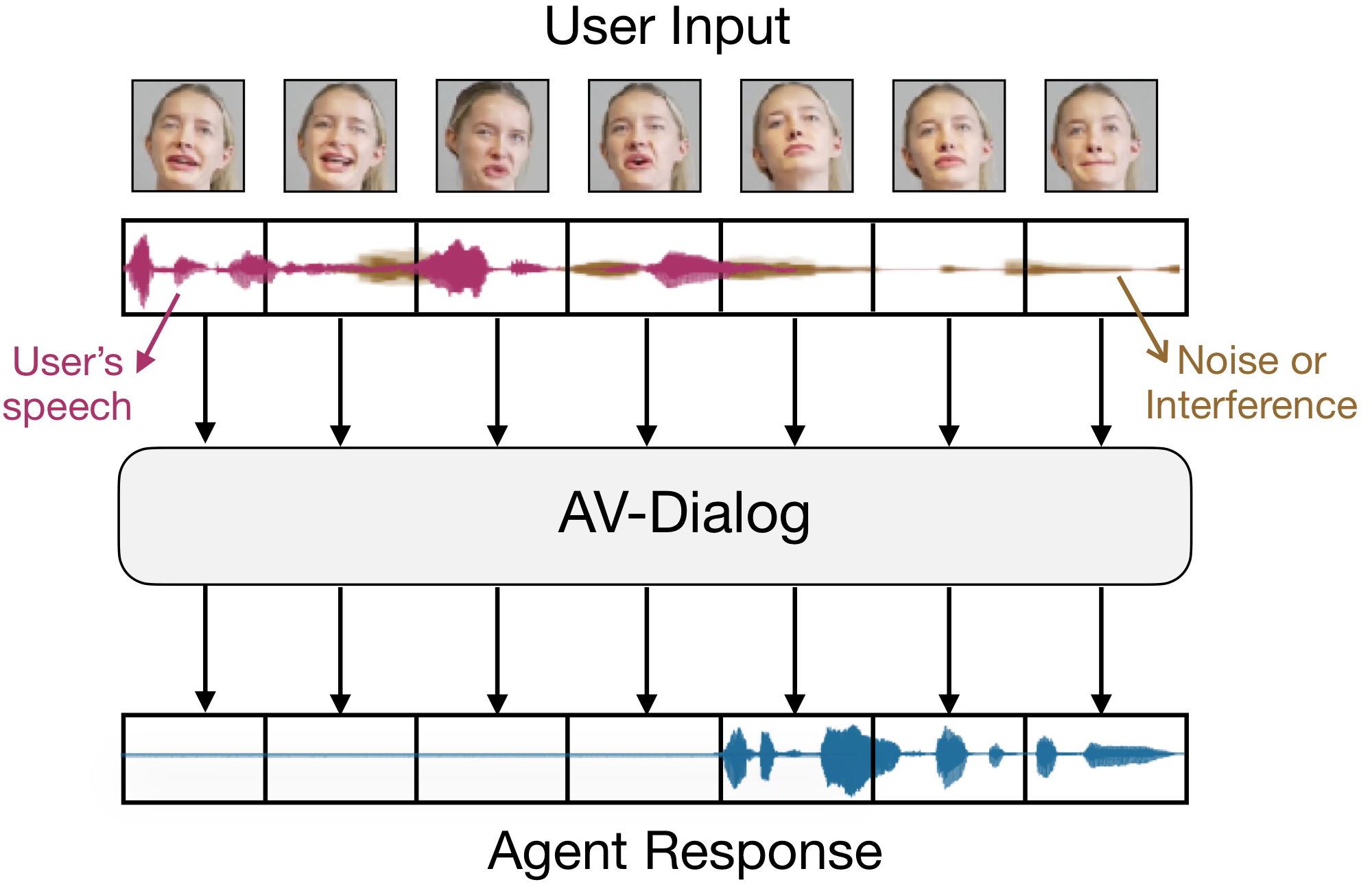
Abstract
Dialogue models falter in noisy, multi-speaker environments, often producing irrelevant responses and awkward turn-taking. We present AV-Dialog, the first multimodal dialog framework that uses both audio and visual cues to track the target speaker, predict turn-taking, and generate coherent responses. By combining acoustic tokenization with multi-task, multi-stage training on monadic, synthetic, and real audio-visual dialogue datasets, AV-Dialog achieves robust streaming transcription, semantically grounded turn-boundary detection and accurate responses, resulting in a natural conversational flow. Experiments show that AV-Dialog outperforms audio-only models under interference, reducing transcription errors, improving turn-taking prediction, and enhancing human-rated dialogue quality. These results highlight the power of seeing as well as hearing for speaker-aware interaction, paving the way for spoken dialogue agents that perform robustly in real-world, noisy environments.
Key Contributions
-
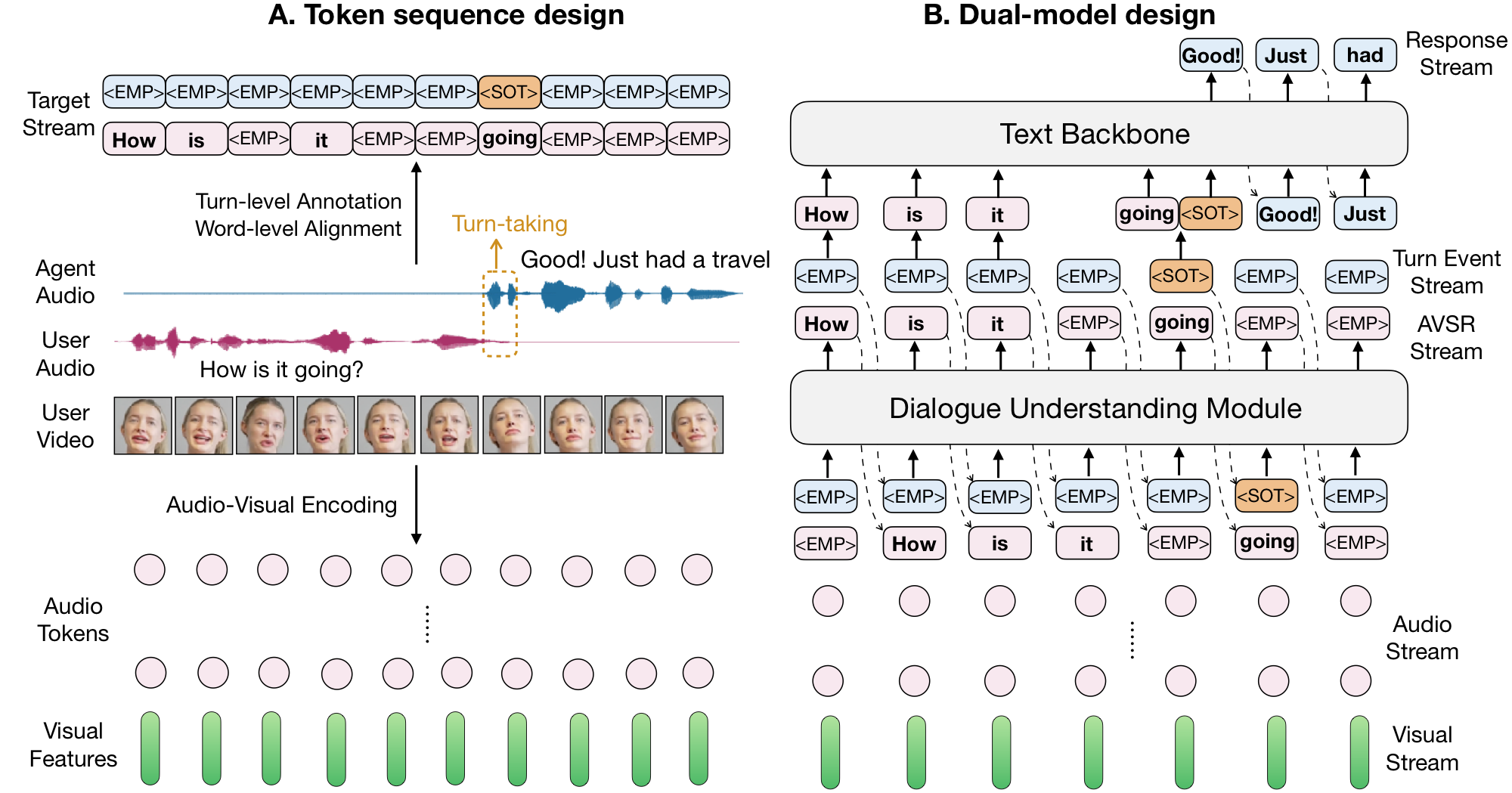
🎯First Audio-Visual Dialogue Framework Built on LLaMA3-8B, AV-Dialog processes audio and video in a streaming manner (40ms chunks) to extract target speaker text tokens under interference and predict turn-change tokens. We explore both dual and unified architectures.
-
🔊Acoustic Tokens for Noisy Multi-Speaker Settings We use general-purpose Descript Audio Codec (DAC) tokens instead of semantic tokenizers trained on single-speaker speech. Acoustic tokens preserve both semantic and raw acoustic information, enabling inherent speaker differentiation — reducing WER under strong interference from 67% to 31.7%.
-
📋Multi-Task, Multi-Stage Training Recipe Stage 1 trains on text prediction, ASR, AVSR, and audio captioning to strengthen audio-visual understanding. Stage 2 fine-tunes on real conversational data with synthetic mixture augmentation to simulate noisy environments (SNR between −8 dB and 8 dB).
Method
AV-Dialog processes multi-stream inputs at each timestep: a continuous visual stream from AV-HuBERT and 16 audio streams from the DAC tokenizer. The model outputs a streaming transcription of user speech and turn-taking event tokens. When a turn-taking token is detected, the system switches from LISTENING to SPEAKING mode and generates a response.
Results
| Model | Dataset | Clean | BG Noise | Interference |
|---|---|---|---|---|
| Auto-AVSR | VoxCeleb2 | 26.8 | 48.2 | 71.8 |
| AV-Dialog (Ours) | VoxCeleb2 | 17.4 | 35.6 | 38.8 |
| Auto-AVSR | LRS2 | 15.8 | 34.0 | 60.0 |
| AV-Dialog (Ours) | LRS2 | 9.53 | 24.0 | 28.4 |
| Model | Response Ratio ↑ | FTO Error ↓ | N-MOS ↑ | H-MOS ↑ |
|---|---|---|---|---|
| SE + Moshi | 54.0% | 3.48 | 2.46 | 2.12 |
| AV-Dialog Dual+ICL (Ours) | 74.5% | 1.86 | 4.12 | 4.02 |
| AV-Dialog Unified (Ours) | 68.1% | 1.68 | 3.67 | 3.09 |
| Ground Truth | — | — | 3.98 | 3.62 |
Human evaluation on N=24 subjects. N-MOS: naturalness mean opinion score; H-MOS: helpfulness mean opinion score. Visual input improves turn-taking accuracy from 54% to 79% under interfering speakers (+13% gain). AV-Dialog achieves +1.66 N-MOS and +1.90 H-MOS over SE+Moshi.